The IFp. Manifesto - Deep Dive
The digital literary landscape is crowded, pristine, and frequently exhausting. On one side stands the traditional academic establishment—gatekept by MFA networks, institutional hierarchies, and centuries of dust. On the other lies the clinical optimization of the modern web — a grid of perfectly curated, algorithm-friendly interfaces where art is routinely sanded down into "content."
Then there is the ifp. (itsfuckingpoetry) collective.
If you have stumbled across this acronym, noticed the lowercase, bold typography, or heard whispers of a platform attempting to break the contemporary editorial mold, you might be wondering what exactly is going on here. On paper, ifp. is an independent literary journal dedicated to poetry and hybrid genres (the gray, lawless territory where poetry bleeds into visual art, essayistic prose, and digital artifact).
But beneath the structural mechanics of a publishing schedule lies a foundational text: The ifp. Manifesto.
This is not a polite call for submissions. It is a radical blueprint for the resurrection of raw, visceral art in an era dominated by hyper-polished curation. For those unfamiliar with the ecosystem, this deep dive breaks down the core philosophy, the artistic warfare, and the structural design of the ifp. movement.
The Core Philosophy: Demolishing the "Precious"
To understand the manifesto, you have to understand the modern sickness it fights. Too much contemporary poetry behaves as if it belongs in a museum behind bulletproof glass. It is overly polite, hyper-conscious of its own intellectual status, and terrified of making a mess.
The ifp. manifesto rejects this preciousness out of hand. The name itself is an intentional shock to the system — a linguistic slap meant to strip away the academic pretension that convinces everyday people that poetry isn’t for them.
Radical Accessibility Meets High Art
The manifesto posits that poetry is not a luxury item or an academic credential. It is a vital, messy, human emergency. By coupling an unapologetically raw, vernacular name with high-concept hybrid literature, ifp. forces a collision between two worlds that are usually segregated:
The Pulp/Street Energy: Art that is immediate, urgent, and fiercely authentic.
The Experimental Vanguard: Art that pushes form, cross-contaminates genres, and challenges how text operates on a page or a screen.
By declaring that the work must be visceral, the manifesto strips away the layer of safe academic comfort. It demands writing leaves a mark — work that feels less like a carefully crafted workshop exercise and more like a physical necessity.
The Human Pulse: Writing as a Lived Event
At the absolute center of the ifp. philosophy is a fierce, unyielding emphasis on the human experience essential to the poetry of writing.
In an era rapidly being flooded by synthetic text and automated language models, the manifesto serves as a reminder that true poetry cannot be manufactured by an algorithm. Poetry is not merely the arrangement of words on a page; it is the translation of biological friction. It is the record of a human body navigating a broken world—sweating, bleeding, grieving, and loving in real-time.
The manifesto argues that the act of writing is itself a raw, visceral human event. It values the typos born of shaking hands, the jagged rhythms of a mind in crisis, and the unpolished truths that slip out when the writer forgets to be polite.
To write poetry in the ifp. universe is to leave a thumbprint on the page. It is an insistence that art must remain tied to the messy, unpredictable, and entirely non-linear reality of being alive. If a piece of writing does not possess that distinct, human heartbeat — if it feels sanitized, sonnet-ized, overly calculated, or emotionally detached — it fails the fundamental test of the manifesto.
Weaponizing the "Hybrid": The Battle for Form
What does it mean when the manifesto champions hybrid genres (poetry+)?
In traditional publishing, genres are neatly boxed. You write a lyric poem, or you write a short story, or you create a graphic illustration. The ifp. manifesto recognizes these boundaries as artificial constraints left over from the limitations of physical printing presses. We live in a digital age; our text can move, our images can breathe, and our prose can fracture into verse at a moment's notice.
The manifesto identifies "poetry+" as a site of artistic resistance. It embraces:
Visual Poetry: Where the layout, typography, and visual weight of the text on the screen hold as much narrative meaning as the words themselves.
Prose-Poetry Fractures: Work that subverts narrative arc in favor of raw sonic texture and emotional velocity.
Digital Textuality: Art that acknowledges the screen it lives on, using the unique architecture of the web to create text that couldn't exist on a standard piece of paper.
This isn’t experimentation for the sake of being clever. The manifesto explicitly warns against hollow avant-garde posturing. The hybridity must serve the emotion. If you are going to break the form, you must do it to express something so volatile that a traditional stanza simply could not hold it.
The Structural Engine: An Active, Continuous Cycle
A manifesto is nothing without infrastructure. The ultimate irony of many artistic movements is that they preach chaos but collapse because they lack the discipline to build an engine. The ifp. architecture is built on a strict, rhythmic publishing timeline that treats the year not as an academic calendar, but as a continuous cycle of creation, release, and sudden disruption.
The ifp. universe operates on a carefully calculated matrix of frequencies:
[ Ink Bleeds (Monthly Blog) ]
Released on the 15th of EVERY Month
|
+-----------------------+-----------------------+
| | |
v v v
Volta (Spring) Volta (Summer) Volta (Autumn)
Release: March 1 Release: July 10 Release: October 1
| | |
+-----------------------+-----------------------+
|
v
Envoi (Annual Anthology)
Release: January 31 (First Release in 2028)
[ ICTUS: POP-UP DROPS (Unscheduled Chaos) ]
Volta. The Flagship (Triannual Journal)
Named after the dramatic turn in a sonnet where the emotional or logical direction shifts, Volta is the flagship publication. Releasing on March 1 (Spring), July 10 (Summer), and October 1 (Autumn), this triannual engine keeps the platform in a constant state of evolution. It means the journal is never static; it changes skins with the seasons, ensuring that the art remains responsive to the immediate cultural moment.
The Monthly Pulse: Ink Bleeds
Manifestos are often written once and left to rot. To prevent this, the platform utilizes Ink Bleeds, a recurring monthly feature dropping on the 15th of every month. This is where the theoretical scaffolding is continually tested. It serves as an ongoing critique, an open studio notebook, and a regular injection of raw commentary that bridges the gap between major volume releases.
The Chaotic Interruption: ictus. Pop-Up Drops
The predictable rhythm of a calendar can sometimes breed complacency, which is why the structural engine includes an element of deliberate instability: ictus.
In prosody, an ictus is the stress or accent placed on a syllable in a line of verse. It is the sudden emphasis, the unexpected strike that dictates the rhythm. Within the ifp. engine, ictus. represents unscheduled, volatile pop-up drops that completely bypass the standard publishing cycle.
An ictus drop happens without warning. It is a sudden flash-release of a single, highly explosive hybrid piece, a raw chapbook, or a fleeting digital artifact. By inserting these erratic bursts of creative energy directly into the machinery, ifp. ensures that the platform mimics the unpredictability of human life itself—interrupted, sudden, and beautifully chaotic.
The Finality: envoi.
At the end of the yearly cycle sits envoi., the annual anthology released on January 31 beginning in 2028. In classical poetry, an envoi is a short, concluding stanza that serves as a dedication or a postscript. For ifp., this publication is a curation of the year’s absolute best—including the standouts from the Volta sequence and the permanent debris of the ictus strikes—bound together to act as a permanent monument to the ground covered over the previous twelve months.
Against the Clean Web: The Anti-Algorithm Aesthetic
Look at the modern internet. Everything is designed to look like a clean, minimalist corporate dashboard. Whitespace is hyper-optimized; colors are selected via mathematical utility to keep your eyes scrolling mindlessly.
The ifp. manifesto is a declaration of war against this aesthetic blandness. It champions what can only be described as digital pulp — an aesthetic philosophy that translates the grit, sweat, and cheap ink of 20th-century underground zines into the digital realm.
The digital pulp aesthetic is an intentional rebellion. It recognizes that if you present radical art inside a layout that looks like a banking app, you neutralize the art. The frame must match the painting. The digital environment of ifp. is constructed to feel alive, slightly dangerous, and distinct from the rest of your browser tabs.
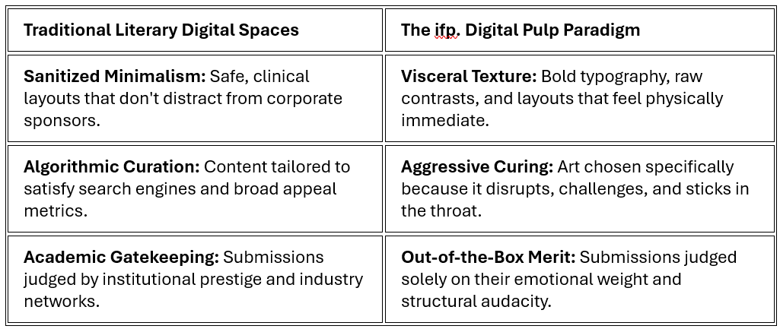
charting the difference between Trad Lit spaces and the ifp. Digital Pulp paradigm
De-Commodification: Writing Against the Dollar
We live in a hyper-capitalist digital economy where nothing is permitted to simply exist. Everything must be leveraged, optimized, and commodified. The moment a piece of art is uploaded, the machine attempts to turn it into "content"—a metric-driven asset designed to capture eyeballs, trigger ad clicks, or build a personal brand.
The ifp. manifesto is a declaration of total economic non-compliance. It positions poetry as a zone of absolute resistance against the monetization of creative expression.
When art becomes a product, it inherently adapts to satisfy the market. Writers begin tailoring their syntax to fit what "performs well" on social algorithms; editors select pieces that won't alienate corporate platforms or university donors. The manifesto rejects this transactional survival game. It treats poetry not as a hustle, a career milestone, or a monetization strategy, but as a deliberate act of economic sabotage.
By prioritizing unmarketable hybrid forms and raw, visceral content over polished, consumer-friendly aestheticism, ifp. builds a space where art is intentionally too jagged to be swallowed by the standard corporate machine. The work doesn't exist to generate revenue or scale an audience; it exists to disrupt. Success is measured not in click-through rates or profit margins, but in the sheer weight of its emotional impact and its refusal to be bought, sold, or streamlined.
The Call to the Uninitiated
If you are reading this as someone who has never engaged with poetry outside of high school textbooks or sterile social media quotes, the ifp. manifesto is an invitation to unlearn everything you think you know about the medium.
It tells you that you do not need a degree to understand a poem. It tells you that if a piece of literature doesn't make you feel something physical—a tightening in the chest, a spark of anger, an unexpected wave of clarity—then it hasn't done its job.
The manifesto isn't asking for passive readers. It is building an ecosystem of creators, agitators, and consumers who want literature to return to its roots: something untamed, highly experimental, and fiercely independent.
The platform is live, the publishing cycle is moving, and the ink is already bleeding. The only question left is whether you’re going to keep scrolling past, or dive headfirst into the dirt with the ifp. collective.
